
Hey folks, tune into @joemangishow at 1 PM today.. My first day on the air after the Super Bowl …. and it is time to address the controversy … since it seems no one had it right… what the controversy was that is!
.OPENING MONOLOGUE —
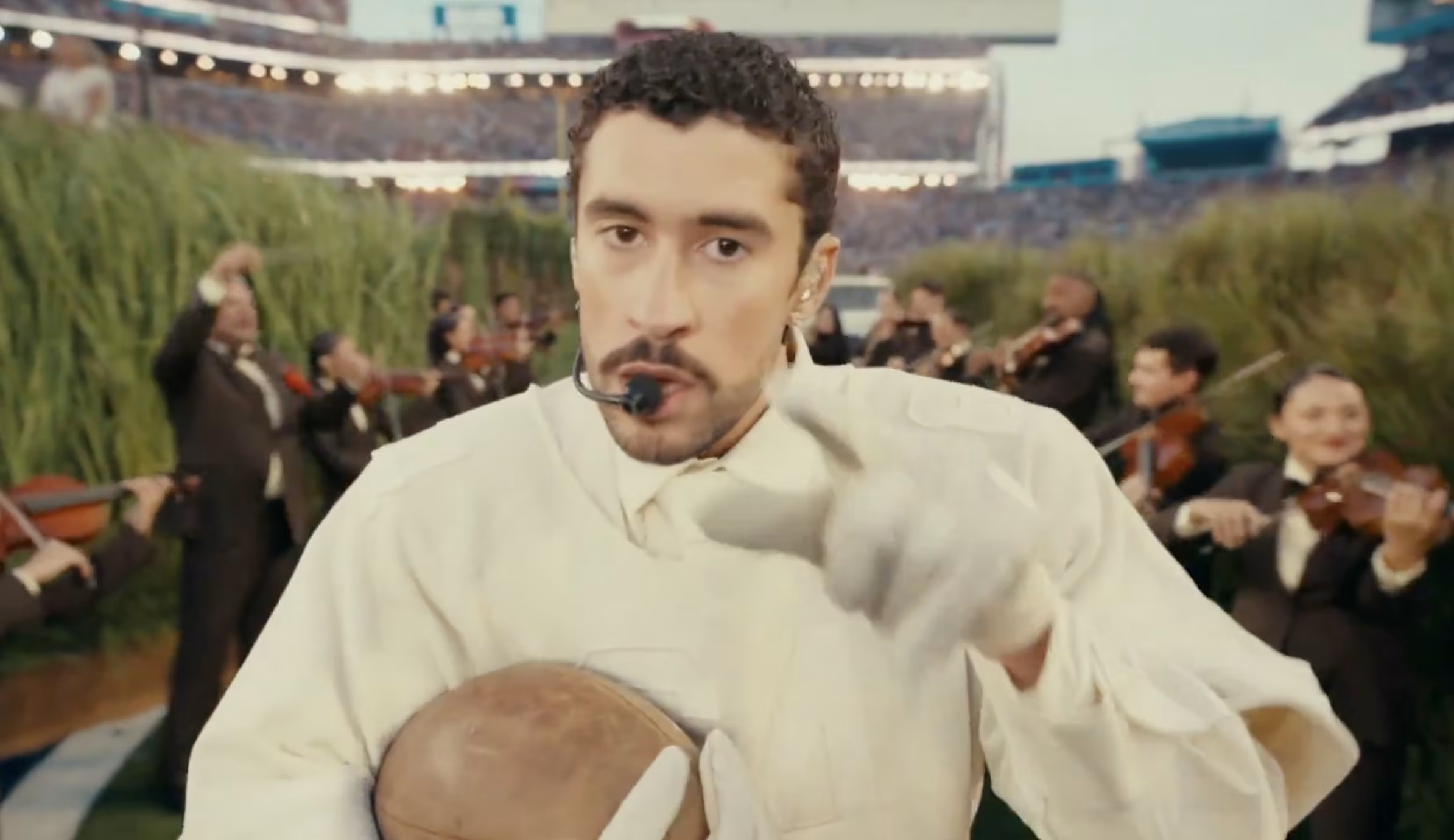
My friends, let’s talk about the Super Bowl halftime show—because whether you loved it, hated it, muted it, or switched to the Turning Point “All-American” counter-show… you knew this was coming. You knew the country was going to be talking about it Monday morning.
And I’ll tell you what: I’m not even going to pretend I was some lifelong Bad Bunny expert. I wasn’t. I had barely heard the name until the controversy became a pregame storyline—days of arguing about whether the NFL was “going woke,” whether the halftime show was “un-American,” whether it was “all in Spanish,” and whether that was somehow the end of Western civilization.
So let me separate the noise from the signal.
First, the language issue.
No—singing in Spanish is not, by itself, “un-American.” Spanish is spoken all over the United States. It’s spoken by American citizens. Puerto Rico is part of the United States. We have millions of Spanish-speaking Americans who serve in our military, run businesses, raise families, and love this country like everybody else. So I’m not doing the lazy thing where we pretend a language itself is the enemy.
But—but—the Super Bowl halftime show is also one of the most watched American cultural events of the year. It’s not a niche concert. It’s not a club. It’s not a festival crowd that opted-in and paid for an explicit tour stop. It’s a national broadcast that’s basically become a family event: kids in the room, pizza on the table, and a remote control in Dad’s hand.
So yes—if you’re going to take the biggest stage in American television, there’s a reasonable expectation you respect the audience you’re speaking to. In an English-speaking country, where most viewers speak English, the smart move—if your goal is unity and connection—is to meet that audience halfway. You can still represent your culture. You can still include Spanish. But you should also show some respect for the fact that most of America is not fluent in it.
Now, let’s talk about what I think is the actual controversy—and I mean the one that any parent watching knows in their gut.
It’s not Spanish.
It’s content.
It’s decency.
It’s the fact that on a broadcast watched by well over a hundred million people, the NFL put songs into a halftime medley that—when you translate them—are loaded with explicit sexual descriptions, degrading references to women, hard profanity, and drug references. And the reason this matters is very simple:
If those lyrics were sung in English—plain as day—there would have been absolute, immediate national outrage. Not “maybe.” Not “some people.” I’m talking: sponsors calling, affiliates panicking, apology tours, and the NFL in damage-control within minutes.
But because it was in Spanish, a bunch of executives apparently assumed, “Eh… most of them won’t know what it says.”
And that right there is the scandal.
Because that’s not respect. That’s not inclusion. That’s not cultural celebration.
That’s using a language barrier as a censorship loophole to smuggle content onto broadcast TV that would never make it past standards and practices if the average viewer could understand it in real time.
Let’s be specific without turning this into a filthy radio show. One of the songs people keep pointing to is “Safaera,” which was part of the halftime setlist. And if you’ve seen translated excerpts—like the ones circulating all over social media—it’s not subtle. It’s not “suggestive.” It’s graphic. It’s profane. It’s crude. It’s the kind of stuff that would get bleeped into oblivion if performed on broadcast television in English.
And I want to ask the question that nobody in the corporate suites wants to answer:
Where were the censors?
Because broadcast television has rules and restrictions around indecent and profane material—especially at hours when children are likely to be watching. That’s not my opinion; that’s the FCC’s framework for broadcast TV and radio.
So did nobody translate the lyrics?
Did nobody care?
Or did somebody translate them and decide, “We’ll gamble that the audience won’t”?
Because if that’s the decision—then don’t tell me this was about “diversity” or “representation.” That’s not representation. That’s corporate cynicism.
Now, here’s what made this even more interesting: the viewership and the counter-programming.
Turning Point USA ran an “All-American” alternative halftime show—big patriotic branding, marketed explicitly as a response to Bad Bunny’s selection. And I’ll tell you what I saw with my own eyes: I was at a Super Bowl party, and people weren’t choosing one or the other. They had both on. They were flipping. They were streaming the alternative show while keeping the official halftime show up on the main screen.
Why?
Because controversy sells.
And that’s why I don’t buy the “record views prove everybody loved it” argument. The official halftime show drew enormous numbers, and the Turning Point stream pulled big attention too. But a chunk of that attention—maybe a lot of it—was driven by the same thing that drives half the modern media economy:
People tune in to see what the fight is about.
They tune in to compare.
They tune in to judge.
They tune in because everybody’s talking.
And by the way, that should be a warning sign for the NFL and every sponsor involved. When your numbers are being juiced by outrage-watchers, don’t confuse that with cultural unity. Outrage is not unity. It’s a sugar high.
Now let me be crystal clear, because I’m not going to play this silly game where if you criticize anything, you get labeled.
If you say, “Hey, this content is inappropriate for kids,” that does not make you “racist.”
If you say, “Hey, the lyrics are disgusting and degrading,” that does not make you “bigoted.”
If you say, “Hey, broadcast TV shouldn’t be a backdoor for explicit sexual content,” that makes you a normal adult with standards.
And it’s especially rich when the same culture that screams about “protecting children” one day, suddenly turns around and says, “Stop clutching your pearls,” the next—because the explicit content came packaged in a language they assume you can’t understand.
No. That’s not how it works.
If you want to argue for edgy adult entertainment, fine. But then admit what you’re doing and put it where it belongs: on adult platforms, adult venues, adult time slots, and adult opt-in settings—not on the biggest family broadcast in America.
The NFL loves to call the Super Bowl a “shared national moment.” Great. Then treat it like one.
That means:
- Respect the audience you’re speaking to.
- Respect that kids are watching.
- Respect that “standards” aren’t oppression—they’re what separates civilization from chaos.
And if the NFL wants to book global artists—and I’m not against global artists—then here’s the deal: you can do it with class, with a clean edit, with a curated set, with a performance that celebrates culture without dragging the whole country into gutter language.
Because there’s a difference between culture… and crudity.
So that’s where I land:
Spanish isn’t the scandal.
A Puerto Rican artist on the halftime stage isn’t the scandal.
The scandal is that somebody in the pipeline let explicitly filthy content ride on a technicality—because they assumed most Americans wouldn’t catch it.
And that’s not just disrespectful to the audience.
That’s disrespectful to the country.
And it’s disrespectful to every parent who’s trying to raise kids with a little decency in a culture that’s constantly pushing the boundaries.
Alright—when we come back, we’re going to open the phone lines. I want to hear from you:
Was this overblown outrage… or was this a real standards failure?
And if the lyrics had been in English—would the NFL still be pretending it was no big deal?
Let’s get into it.